
Content
Pull the outfit together from the ankles up. A navy suit with brown leather shoes is one of the most versatile combinations in a man’s wardrobe, but it often stalls when you reach the sock drawer. What color socks actually work with a blue suit and brown shoes? The short answer is that a pair of deep navy dress socks is the safest and most classic choice; the more interesting answer depends on how much personality the occasion allows.
This guide walks through the traditional rule, the modern alternatives, and the fit and fabric details that separate a good outfit from a merely color-matched one. If you are still mapping out your wardrobe basics, the principles in choosing the right men's socks for every occasion apply here as well.
Formal dress etiquette has a firm rule: you wear socks that match the trousers, not the shoes. With a navy suit, navy socks create a single clean vertical line from the waist down to the shoe. Brown shoes act as a solid, grounding base, but they should not dominate that line. This is why, in an interview, a courtroom, or a client dinner, navy is the obvious answer.
From a distance, the eye reads the trouser and the sock as one unit. If the sock is a sharply different color, the brain registers a break in that line and the legs look shorter. Matching the sock to the trouser means the transition to the shoe is the only visible shift, which is why so many classic menswear guides describe the sock as a bridge rather than a statement.
Full business dress is still rigid in many banks, law firms, and traditional corporate offices. In those environments, solid navy socks in a reasonably heavy cotton or wool blend are never the wrong call. The sock should be opaque, long enough to stay up, and free of logos or bright sporty stripes.
Beyond traditional settings, a blue suit and brown shoes are already one step away from the stricter formality of black shoes. That gives you latitude to choose a sock color that is not navy but still sits naturally between the trouser and the shoe.
Charcoal grey is the quiet alternative. It is not as visually seamless as navy, but it reads as a deliberate neutral, especially in a wool or cotton-wool blend. Choose this when the navy suit is doing daytime work and you want the socks to stay out of the conversation.
Warm brown shoes invite warm sock colors. Burgundy, sometimes called oxblood, occupies a middle ground: it relates to the warmth of the leather yet remains distinct enough to be noticed when you cross your legs. It is the most popular way to add a subtle accent to a navy suit without moving anywhere near bright.
Dark green, in a forest or bottle tone, is an underrated companion to navy and brown. It echoes the natural pairing of brown and green, and it looks especially strong in autumn or winter. Keep the shade deep enough that it does not compete with the suit.
When the dress code is business casual or an evening social event, patterned socks are where you can express a bit of taste. Argyle, micro-checks, small dots, and understated jacquards all work with a blue top block and brown shoes. The key is to keep the pattern dense and the background color close to the trouser color.
Jacquard knitting is one of the cleanest ways to produce these patterns, because the design is woven into the fabric rather than printed or embroidered on top. If you are shopping for ready-to-wear socks, look for a dense knit in a navy or charcoal base with a small repeating motif. A pair of jacquard check-pattern dress socks is a typical example of the style that works in a business-casual wardrobe.
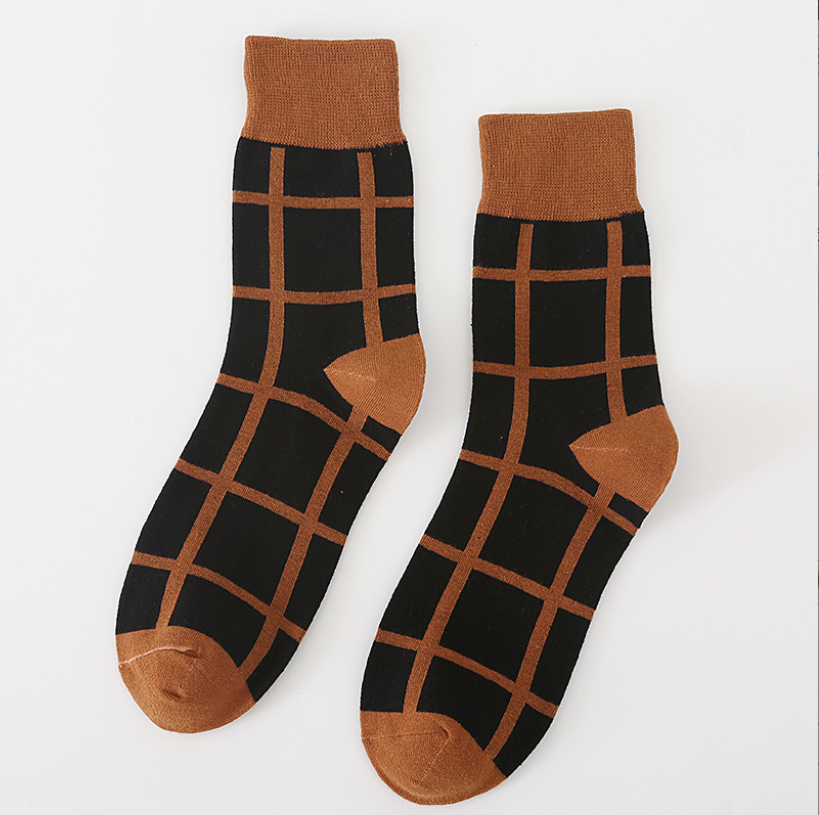 Wholesale New Jacquard Dress Check Pattern Crew Custom Cotton Men's Socks FormalHaining Wanshida Hosiery Co.,LTD is China wholesale New Jacquard Dress Check Pattern Crew Custom Cotton Men's Socks Formal suppliers,Item...View Product →
Most sock mistakes with a navy suit and brown shoes are not really about color. They are about length, context, and the health of the visual line.
The most common failure is visible skin when you sit or cross your legs. Ankle socks and no-show socks have no place under dress trousers. Your sock needs to reach at least mid-calf, which in practice means a crew-length or knee-high sock. Combined with a cuff that holds its position, this eliminates the so-called sock gap entirely.
White athletic socks, neon tones, and heavily branded sport socks are designed for training, not tailoring. They flash above the shoe and change the entire reading of the outfit. If you are moving from a casual wardrobe into suited dressing, retire these first.
Very light pastel socks, such as powder blue or ice grey, tend to read as a lighter block against the dark trouser, which cuts the leg line. In almost every case, keep the sock equal to or darker than the trouser tone.
The color conversation matters, but a poorly made sock can ruin the best pairing. Over years of manufacturing socks for wholesale and custom orders, we have seen the same problem repeat: men focus on the shade and ignore the construction. This is a distinction worth understanding in practical terms, because sock design really does differ between formal and athletic settings.
At a minimum, a dress sock should be long enough that no skin appears when you are seated. The secondary issue is whether it stays up all day. That depends on the yarn composition and the cuff design. A ribbed cuff and a blend containing nylon or elastane provide grip without squeezing the calf.
For daily use, combed cotton is the workhorse. It breathes well, feels soft, and holds color cleanly. In warmer months, bamboo fiber or a cotton-bamboo mix gives a lighter hand. For cold weather, a merino wool or wool-cotton blend provides warmth without the itch. A pair of classic formal men's socks in a soft cotton knit will cover most of these requirements, regardless of the exact fiber.
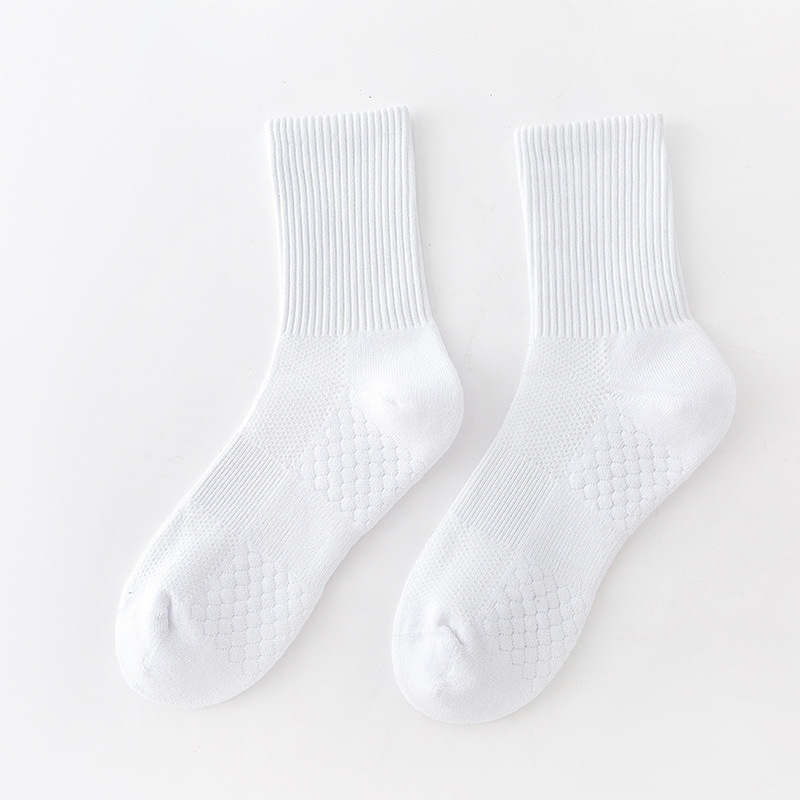 Wholesale OEM Designer Fashion Classic Formal Custom Mens Sports Socks Knit PerfHaining Wanshida Hosiery Co.,LTD is China wholesale OEM Designer Fashion Classic Formal Custom Mens Sports Socks Knit Performance Polyest...View Product →
Hand-linked toes remove the thick seam that can bother you inside shoes. Reinforced toes and heels add durability, especially when the sock rubs against leather linings. The density of the knit also changes the look: a finer gauge gives a dressier surface, while a looser knit reads as casual. From a factory perspective, the sock is a precision piece, not a disposable add-on.
Keep this table in mind the next time the suit is hanging on the door and the brown shoes are waiting on the floor.
| Sock color | Formality | Best for | Effect |
|---|---|---|---|
| Navy | High | Business meetings, interviews, formal events | Seamless line with the trouser; safest choice |
| Charcoal grey | High to moderate | Office wear, conservative casual | Neutral and quiet contrast |
| Burgundy / oxblood | Moderate | Business casual, evening functions | Warm, refined accent |
| Dark green | Moderate | Autumn and winter outfits | Subtle natural pairing with brown leather |
| Subtle patterns | Moderate | Creative workplaces, personal signature detail | Adds character without breaking the line |
Start your dress sock drawer with the fundamentals. Three pairs of navy, two pairs of charcoal, and one pair of burgundy give you a full professional week without any morning friction. Once that baseline is in place, add a patterned pair for days when the dress code allows a bit more freedom.
Consider the evening factor. The same navy suit with brown shoes can move from a daytime office to an evening reception simply by swapping a navy sock for a burgundy or a dark patterned one. That small change alters the character of the outfit while leaving everything else intact.
Season and occasion both matter. Summer favors thinner cottons and lighter tones; winter supports wool blends and deeper colors. Weddings usually allow some personality, while funerals and formal ceremonies call for strict navy. When the situation is unclear, navy is never a bad bet.
Once the combination is polished, how you care for the socks determines how long they last. Wash them in cool water, avoid the dryer, and store them flat or rolled. For the full routine, check our best practices for washing and caring for socks.
To close on a clear note: a blue suit with brown shoes pairs beautifully with navy socks. That is the direct answer to the question most men are asking when they stand in front of the drawer. The second layer of the answer is that you have legitimate room for charcoal, burgundy, dark green, or subtle patterns as long as the occasion permits.
The lasting rule is structural rather than purely chromatic. Choose a sock that matches the trouser closely, reaches the calf securely, uses a fiber suited to the temperature, and holds its shape through the day. Once those conditions are met, the color question becomes a simple one.
NO. WSD1306 Size EU35-39 Age Adu...
View More
NO. WSD1410 Size EU35-39 Age Adu...
View More
NO. WSD1290 Size EU35-39 Age Adu...
View More
NO. WSD1400 Size EU35-39 Age Adu...
View More
NO. WSD1132 Size EU35-39 Age Adu...
View More

+86-13586371153
+86-0573-87670680
[email protected] [email protected]
8-1 Yongsheng Road, Qianjiang Industrial Park, Dingqiao, Haining, Zhejiang, PRC
Copyright © Haining Wanshida Hosiery Co.,LTDAll Rights Reserved. China Custom Socks Manufacturers